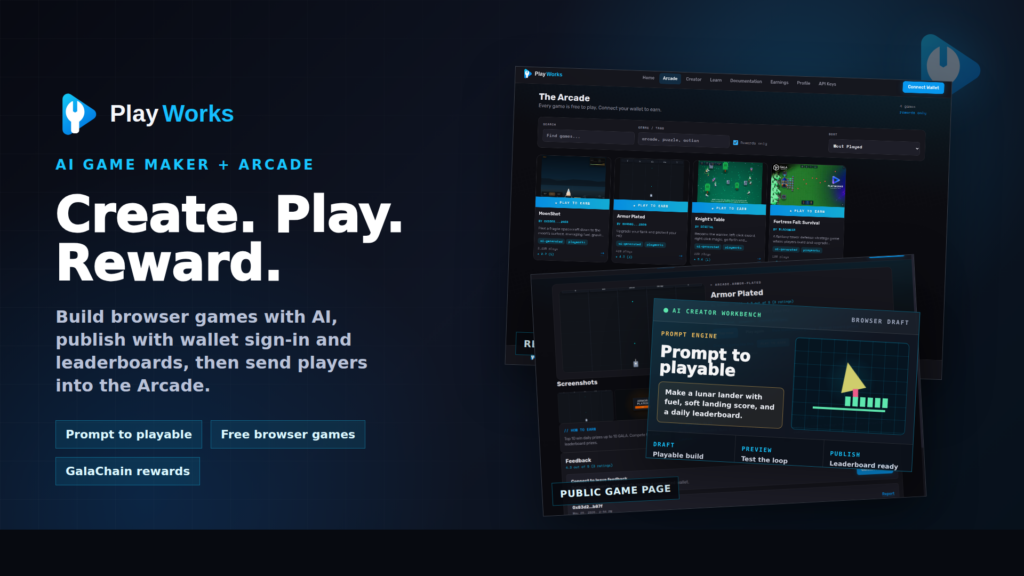
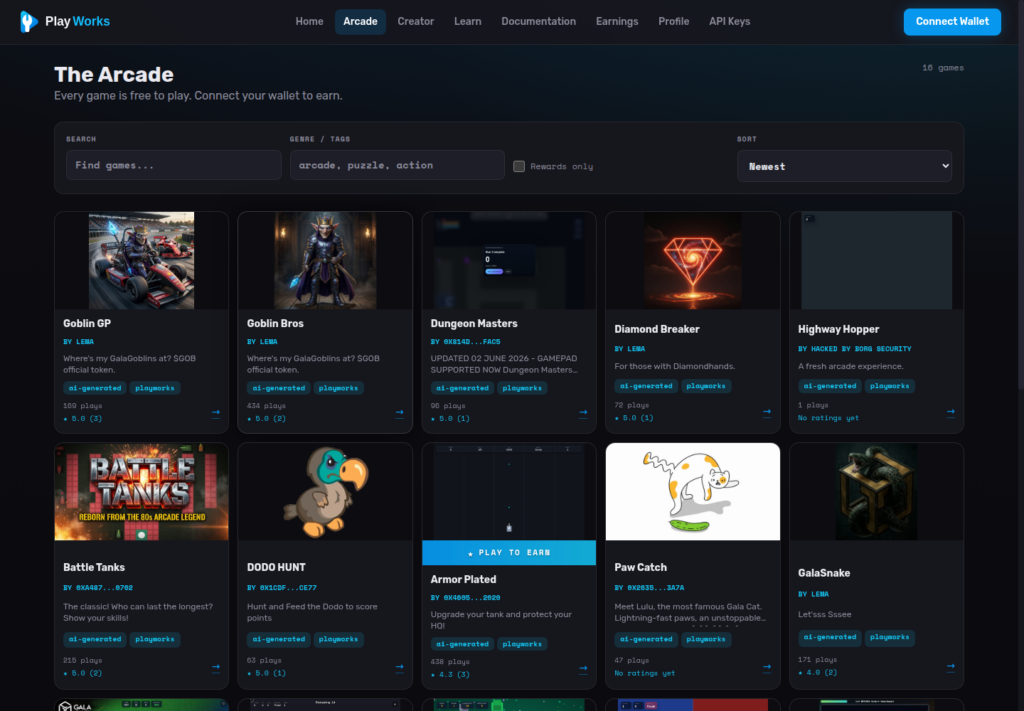
Gala Playworks lets creators describe a game idea, generate a playable HTML5 draft, test it in the browser, and publish it with leaderboards, wallet sign-in, and optional reward controls.
Free Publishing Week: Creators can publish a Playworks browser game without the standard publishing fee through June 12, 2026. Generate a draft, test the loop, and publish during the promo window when the game is ready.
If you are looking for an AI game maker for browser games, the hard part is not only getting code on screen. The useful part is getting a draft you can play, revise, publish, and show to players without leaving the creation flow.
This guide shows how to write a stronger first prompt, what to check after the first generated draft, how to refine the prompt when the game feels wrong, and how public Playworks examples can help you decide what to build next.
Publishing and reward setup should still follow the terms shown in the product. The waived publishing fee does not make creator-funded reward pools, eligibility rules, or other game terms free by default.
Quick start
Pick one core loop players can understand in ten seconds.
Describe controls, scoring, fail state, visual style, and level pacing.
Generate a draft in the Gala Playworks AI game maker.
Test the feel, revise the prompt, then publish when the loop works.
A good prompt gives the AI game creator the same details a teammate would need before building a prototype. Name the genre, the player action, the threat, the scoring rule, the fail condition, the level structure, and the style of feedback players should see.
Starter prompt
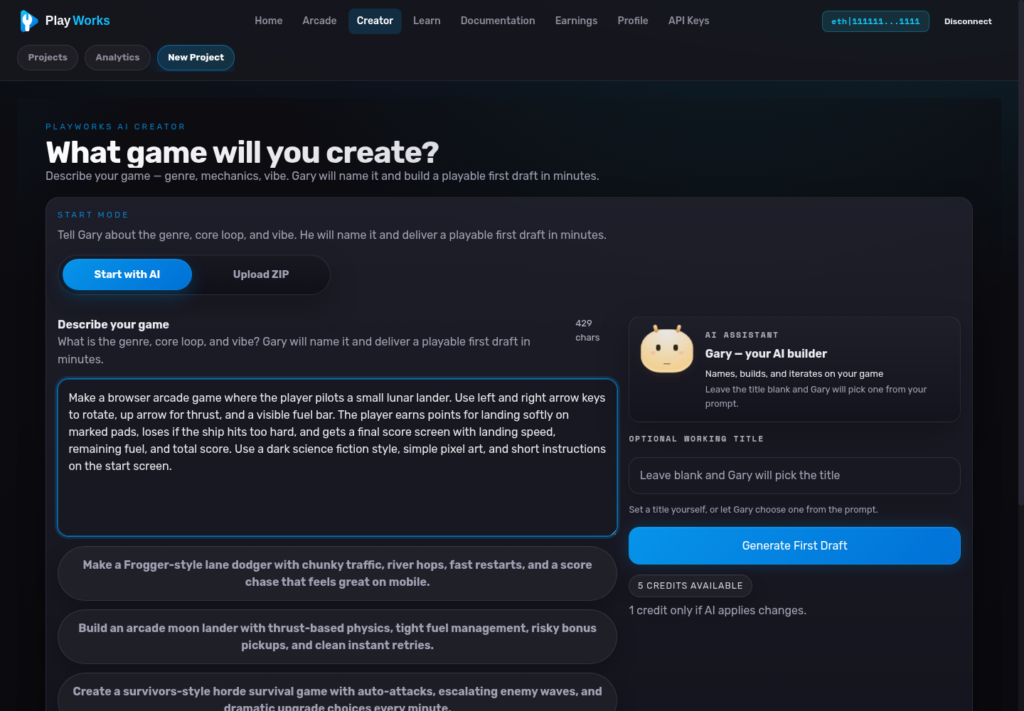
Make a browser arcade game where the player pilots a small lunar lander. Use left and right arrow keys to rotate, up arrow for thrust, and a visible fuel bar. The player earns points for landing softly on marked pads, loses if the ship hits too hard, and gets a final score screen with landing speed, remaining fuel, and total score. Use a dark sci-fi style, simple pixel art, and short instructions on the start screen.
That prompt works because it names the controls, physics goal, scoring, failure, result screen, and art direction. The AI has fewer assumptions to make, and you have a clearer checklist for judging the first draft.
Three AI game prompts to try
Use these as starting points, then change the theme, controls, enemies, score rules, or win condition. The best first game idea is small enough to test quickly and specific enough that the result can be judged.
Lunar landing score chase
arcade
Make a lunar lander game with one-screen levels, limited fuel, landing pads with different score multipliers, and a leaderboard score based on soft landing speed, remaining fuel, and number of safe landings.
Top-down tank defense
action
Make a top-down tank defense game where the player protects a base from waves of drones. Use WASD movement, mouse aiming, upgrade choices between waves, and a score bonus for keeping the base above 75% health.
Space wave survival
shooter
Make a browser space shooter with short waves, collectible shields, enemies that enter from clear warning lanes, and a final results screen showing wave reached, enemies destroyed, damage taken, and score.
How to improve the first draft
The first generated game should be treated like a playable draft. Run it, find the part that feels weakest, then ask for a specific revision. Broad feedback like “make it better” is less useful than changing one rule, speed, enemy behavior, or score moment at a time.
Weak revision prompt
“Make the game more fun.”
Better revision prompt
“Reduce player acceleration by 20%, add a fuel warning when fuel drops below 25%, make the landing pad wider in the first level, and show a score breakdown after each attempt.”
Problem
Prompt fix
Players do not understand the goal.
Ask for a start screen with one sentence of instructions, visible goal markers, and a result screen that repeats the scoring rule.
Controls feel floaty or harsh.
Name the control feel you want: slower acceleration, stronger braking, snap turning, short dash cooldown, or lower gravity.
The game becomes unfair too quickly.
Request wave pacing, warning indicators, enemy spawn caps, a gentler first level, and one safe recovery mechanic.
The score does not teach replay strategy.
Ask for score categories such as survival time, accuracy, resources saved, streaks, bonus objectives, and penalties.
Use published Playworks games as references
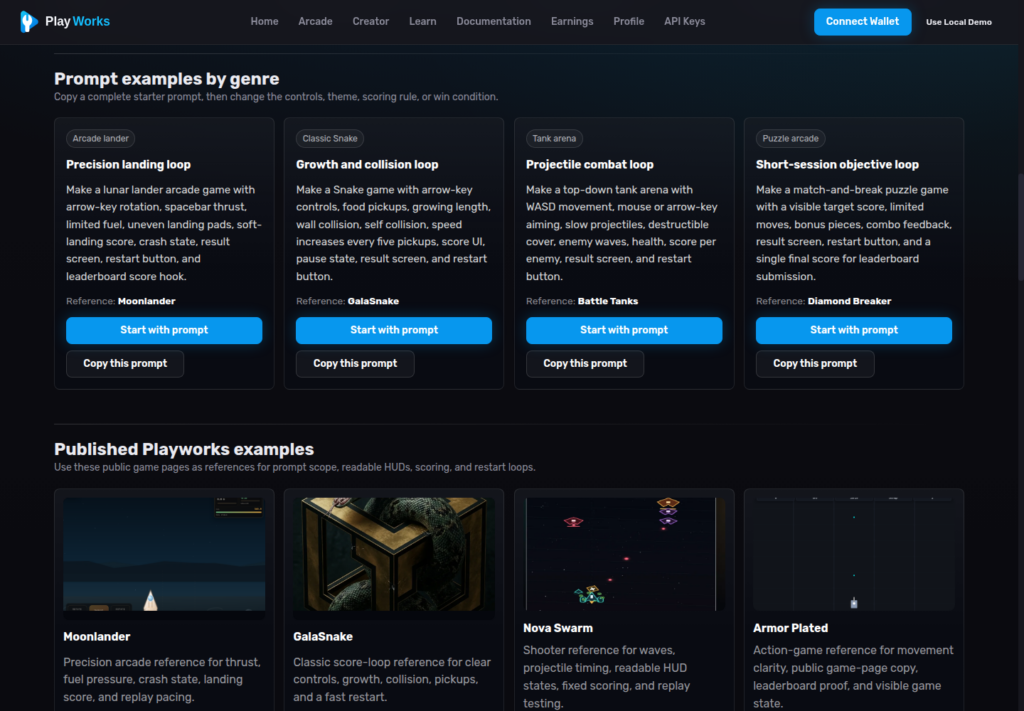
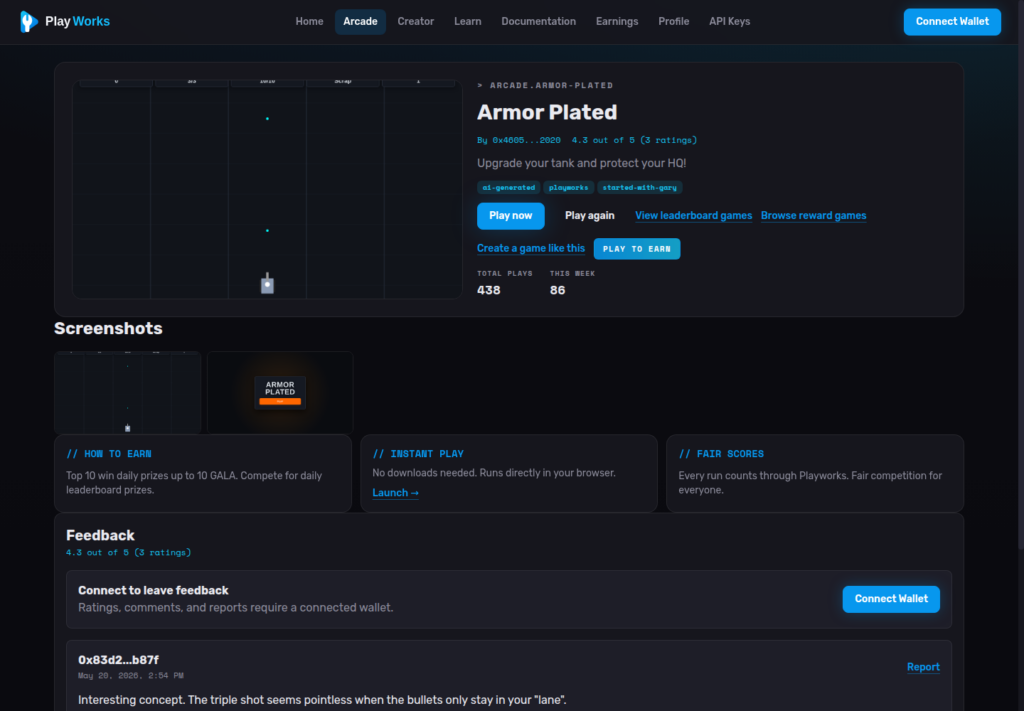
Public examples are useful because they show what a finished browser game page needs after the prompt is done: a playable build, clear launch action, rating and feedback signals, leaderboard entry points, and a creator path for making something similar.
Start with a reference like Moonlander, Armor Plated, or Nova Swarm. Then describe what you want to keep, what you want to change, and what the new player goal should be. This gives the AI game maker a concrete pattern without asking it to copy the original game.
A useful reference prompt might say: “Use the readable one-screen action of Armor Plated, but make the player protect a moving convoy, add upgrade choices after each wave, and score based on convoy health plus enemies destroyed.”
The creator work does not end at generation. Once a draft is fun enough to publish, the public game page and Arcade help players find it, play it, rate it, and compete on scores. Reward-enabled games can also show wallet and eligibility context before a player enters a competition.
Keep reward language precise. Rewards are available only in eligible games and according to the terms shown for each game. A strong creator prompt should still focus first on the playable loop, because the leaderboard only matters if players want another run.
Start with one playable loop
The fastest path is a small idea with a clear score. Write the prompt, generate the first draft, play it long enough to find the weak point, then revise one specific thing. When the result is understandable and replayable, publish it and use player behavior to decide what to build next.
Rewards are available only in eligible games and according to the terms shown for each game. Confirm live reward terms before naming any token amount or payout rule.
Editor note: Replace local image paths with uploaded Media Library URLs before publishing on News Gala. Confirm the Free Publishing Week date window before publishing if this article goes live after June 12, 2026.
Last week, the GalaChain community was presented with an important decision: how to evolve the network’s economic model to support its next phase of growth.
The vote has now concluded.
The result is in. YES has passed.
This marks a major milestone for GalaChain. With strong support from node operators, the network will move forward with the transition to a disinflationary emission model, bringing fee-sharing, permanent burns, and a long-term economic structure designed for sustainability.
What This Means
With the approval of the proposal, GalaChain enters a new phase built around stronger incentives, predictable emissions, and a model aligned with one of the most successful Layer 1 ecosystems in crypto.
The upgrade introduces:
A disinflationary emission schedule starting at 15% with a 15% annual decay
A 1.5% permanent emission floor, ensuring ongoing rewards for node operators
50% of all gas fees distributed directly to node operators
50% of all gas fees permanently burned, reducing total supply over time
This replaces the previous gap-based model and removes the reflexive minting behavior tied to token burns. From this point forward, every burned token is permanently removed from circulation.
A New Era for Node Operators
For node operators, the impact is immediate and meaningful.
Day 1 rewards are expected to increase significantly,based on current assumptions, alongside the introduction of continuous fee-sharing. Network activity now directly contributes to operator rewards.
Combined with the permanent emission floor, this establishes a long-term incentive structure designed to support operator long term participation by node operators.
What Happens Next
With the vote approved, the network will begin moving toward implementation of the new economic model. Updates will be shared as progress continues and key milestones are reached.
GalaChain has come a long way. What started as a gaming-focused Layer 1 has grown into a full ecosystem, with real volume flowing through GalaSwap and GalaPump every day, and a community that helped build it every step of the way.
The momentum is clear. Thousands of users are transacting on GalaChain every day, and thanks to the friction-reduction work across the ecosystem, even AI agents are now able to operate natively on the chain. Shrapnel is migrating its entire economy onto the chain. A partnership with China’s Trusted Copyright Chain is opening a compliant pathway to 600 million gamers. The foundation is live, and there’s every reason to be proud of how far GalaChain has come.
With that foundation in place, there’s an opportunity to make GalaChain even stronger. The ecosystem has outgrown the economic design it launched with, and the chain is ready for the kind of engine that powers the biggest networks in crypto. Bigger node rewards, real burns, real fee-sharing, and a model built to run forever. This is the moment to set GalaChain up for the next decade.
Next Steps
With the ecosystem in this shape, the natural next step is giving it an economic engine that can carry it forward for the long term. That means bigger node rewards, fee-sharing that pays operators directly, and a model designed to run forever.
The original emission model was built for an earlier phase. It did its job. But GalaChain has grown into a full ecosystem with live DeFi, gaming economies, and AI-driven transactions. The economics need to match.
GalaChain is proposing to adopt the same disinflationary model used by Solana, Ethereum, and Cosmos. Starting at approval, emissions follow a defined rate that decays aggressively each year and settles at a permanent floor. This is the proven standard for Layer 1 blockchains.
What This Means for Node Operators
For node operators, everything changes. Day 1 rewards increase approximately 3.2x from current levels. The permanent floor means no node ever earns zero. Fee-sharing goes live alongside the upgrade: 50% of all gas fees on GalaChain flow directly to node operators. Every swap, every token launch, every in-game trade pays you.
What This Means for the Chain
Under the old model, burning GALA actually triggered more minting. That’s over with this upgrade. Every burned token is permanently removed.
The Vote
Question: Should GalaChain’s emission model be upgraded from the current gap-based system to a disinflationary emission model with fee-sharing for node operators?
Yes — I support upgrading to the disinflationary emission model (15% starting rate, 15% annual decay, 1.5% permanent floor) with 50% of all gas fees distributed to node operators and 50% burned permanently. I understand this replaces the 50 billion hard cap with a declining emission rate, increases Day 1 node rewards approximately 3.2× from current levels, and establishes a permanent income floor.
No — I do not support this change. The current gap model should continue as-is. I understand that under the gap model, emissions will continue declining toward zero within 2–3 years and node operator income will decline accordingly.
Abstain — I choose to abstain from voting on this proposal. I acknowledge the significance of this economic decision but require more information or am neutral on the proposed changes.
How to Vote
Every active Founder’s Node receives one vote. The voting window is open till UTC — April 24, 2026 — 00:00, and all node operators will be able to cast their vote directly at https://node.gala.com/. Review the full proposal and economic model before voting.
Vote ends in UTC — April 24, 2026 — 00:00 Washington (EDT) — April 23, 2026 — 8:00 PM Los Angeles (PDT) — April 23, 2026 — 5:00 PM
The wait is over. Legends & Dragons has returned, bringing back the action-packed gameplay fans love, now ready to dive into on mobile.
Fast Battles. Real Progress.
Step into a world where every fight matters. Build your team, jump into intense battles, earn powerful loot, and keep pushing forward. The game is built around momentum. The more you play, the stronger you become, unlocking new challenges and better rewards along the way.
The Grind, Done Right
If you enjoy progression-driven RPGs, this is where it clicks. Every upgrade feels earned. Every drop has value. Every session moves you forward. It is simple to start, but hard to put down.
Play Anytime, Anywhere
Available now on iOS and Android, Legends & Dragons is designed for quick sessions or longer play runs, depending on how deep you want to go.
Jump In Now
Your next battle is waiting.
Play now: iOS: https://links.gala.com/legends-dragons-ios Android: https://links.gala.com/legends-dragons-android
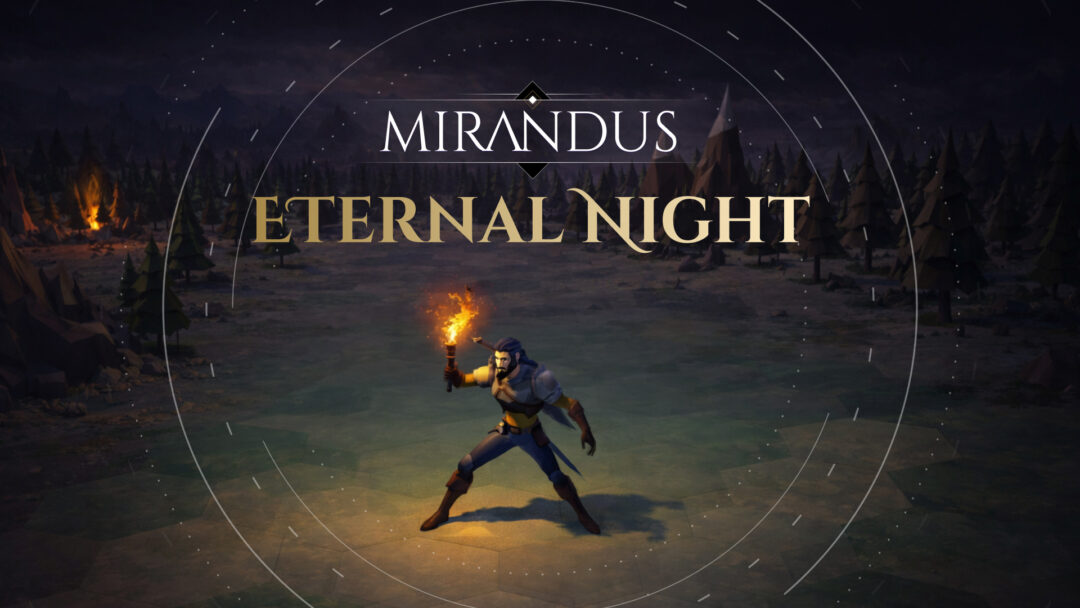
A new chapter in the Mirandus universe begins.Mirandus: Eternal Night is a persistent multiplayer fantasy experience where light and darkness define survival, economy, and power.
A World Falling into Darkness
The sun is fading. Darkness is spreading.
Cities stand as fragile pockets of light. Beyond them lies danger — and opportunity.
Every step into the unknown is a risk. Every return to safety is a victory.
Two Ways to Play, One Shared World
⚔️ Adventure (Open to Everyone)
Explore a hex-based world under fog of war. Fight enemies, gather loot, and make it back alive.
Explore → Risk → Loot → Return → Repeat
Push your luck… or lose everything.
🏰 Ownership (Shape the World)
Own towns, place shops, and control trade. Capture value from player activity and influence the map itself.
Build the light. Control the flow.
Light vs Darkness
Light is safety. Darkness is opportunity.
Light drives trade, visibility, and player activity
Darkness increases danger — and rewards
Cities grow… and attract raids
The world constantly shifts
No place stays safe forever.
A Living World
This is a shared, persistent world:
Finite resources
Player-driven economy
Expanding cities and shifting power
Raids that alter the balance
Your actions matter. The world remembers.
What Comes Next
We’ve already kicked off development and will be sharing playable builds very soon.We’re also preparing a live in-game event system, bringing players together around a world-driven encounter with real rewards and impact.